

“Strong self-management helps people become well-organized, resulting in the ability to plan, prioritize, and execute essential activities.” -Colleen Reilly, Self-Management Skills Necessary At Work And Home
The workplace is evolving. Influence is no longer reserved for only people with an executive title or a corner office. Employees and middle managers are starting to realize that you don’t need formal authority to spark change, guide your peers, or move important work forward. As a result, informal leadership is becoming a powerful driver of career success, helping professionals build trust, shape decisions, and make a meaningful impact on their organizations.
This shift is happening for a reason. As remote work, cross-functional collaboration, and matrixed structures become the norm, traditional hierarchies are struggling to keep up with the complexity of modern workplaces. Many leaders are unsure how to navigate this shift. Those who are able to accept the movement toward self-management and self-directed teams empower employees and help their organizations become more agile.
Studies show informal leaders consistently outperform formal managers in building relationships and inspiring teams. The reasons are clear: formal leaders rely on their position of power and authority to direct employees and teams, while informal leaders inspire and guide others without an official title by earning trust, demonstrating technical competence, and building meaningful relationships.
Successful organizations know that, more than a title, the ability to inspire, persuade, guide, and collaborate across teams is a critical competency for successful leaders.
4 Skills Required for Effective Informal Leadership
As organizations become flatter and more collaborative, the ability to lead without authority has become both a critical career advantage and a necessity for organizational success. These four skills are the building blocks of informal leadership and the key to thriving in a fast-changing workplace:
1. Cultivate Strong Relationships
The foundation of informal leadership is trust. Leaders who connect with colleagues through empathy, curiosity, and open communication create the bonds that drive collaboration and long-term success.
Practical Tips:
- Ask Thoughtful Questions. Open-ended questions like “How can I support you?” encourage dialogue and understanding between leaders and employees.
- Say “Yes, and” instead of “Yes, but.” This language can help foster collaboration and validate others’ perspectives.
- Seek Feedback and Reflect. Taking feedback into account alongside personal reflection is important for improving emotional intelligence and forming stronger relationships.
2. Influence Without Authority
True influence doesn’t require a title because it comes from listening, understanding motivations, and guiding others toward shared goals. Effective informal leaders focus on others’ needs first and cultivate trust to inspire action.
Practical Tips:
- Find Common Ground. Aligning around shared goals strengthens collaboration.
- Adopt a “We” Perspective. Prioritizing team success over personal agendas builds credibility and trust.
- Deliver Consistently. Consistently delivering reliable, high-quality work reinforces influence and authority without formal power.
3. High Performance and Competence
Skills and results give informal leaders credibility. By excelling in your area of expertise and consistently delivering outcomes, you will earn respect and amplify your ability to lead informally.
Practical Tips:
- Master Your Craft. Strong technical or functional competence builds trust.
- Exceed Expectations. Delivering consistently high-quality work inspires confidence and motivates others.
- Lead by Example. High performers set standards and influence peers by showing what is possible.
4. Advanced Self-Leadership
Before you can lead others, you must first lead yourself. The most effective informal leaders demonstrate strong self-leadership, including self-awareness, emotional intelligence, adaptability, and a commitment to continuous learning. This foundation helps professionals navigate complex workplace dynamics with confidence and authenticity.
Practical Tips:
- Develop Self-Awareness. Understand your strengths, weaknesses, and emotional triggers.
- Adopt a Growth Mindset. Embrace learning, feedback, and adaptability.
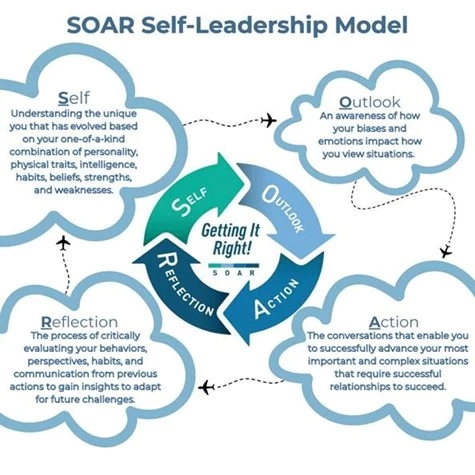
SOAR Model
Leaders who wish to lead by example can learn from the SOAR Model, a research-backed framework for building personal and professional effectiveness. The Model was introduced in Getting It Right When It Matters Most (Gambill & Carbonara, 2021).